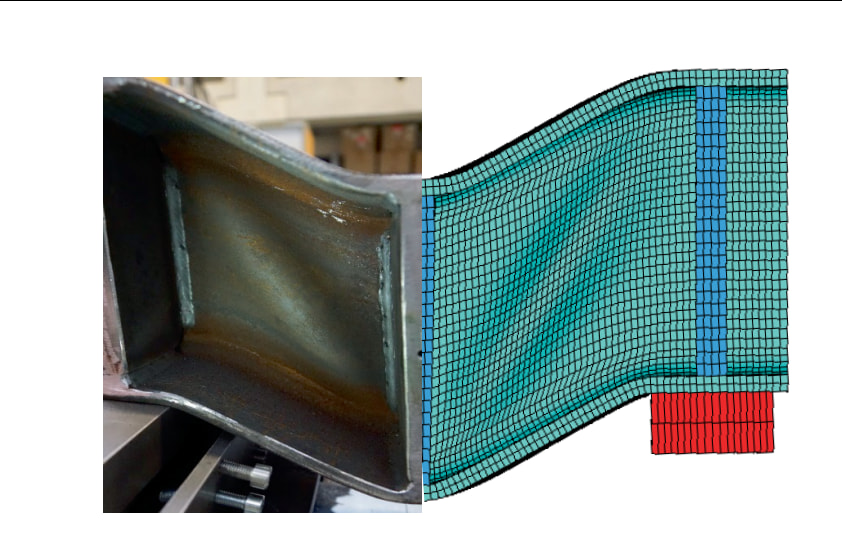
I am trying to evaluate web buckling in the deep beam shown here. I have two compound parts, the deep beam with stiffeners and a smaller beam that applies equal forces on both sides to contact the top flange of the deep beam and develop buckling and stress in the web. I am using a reference point at each end of the small beam, tied to the outline of the end face, and applying a boundary condition at those reference points that restrains all degrees of freedom except translation in the Z direction.
I have tried several approaches but I still cannot get the analysis to run properly. I ran a frequency analysis and it completed without issues, and the mode shapes appear reasonable.
I did not test your model, but using rigid connections and shell elements in Caclulix is not advisable. From your description, I think you can easily replace them with boundary conditions. It should help to remove one possible cause of problems.
If you are planning to perfom some initial test to check Prepomax response and the model itself is not much important, I would suggest you to follow the document rcm-2017-4-ar-1.pdf that can be downloaded freely after registration in the CTICM webpage.
Your section looks like very familiar and there you can find some guidance and the reference solution for this kind of problem. It can help you to achieve the right set up for future projects.
Thanks @Matej , I eliminated the rigid connections and changed for boundary conditions and applied my load as a traction load and that worked as well. Thank you!
This error usually means there’s an overconstraint in the model - some constraints (rigid bidy, tie, contact, BCs) overlap.
And unfortunately, not possible with CalculiX 2.23.
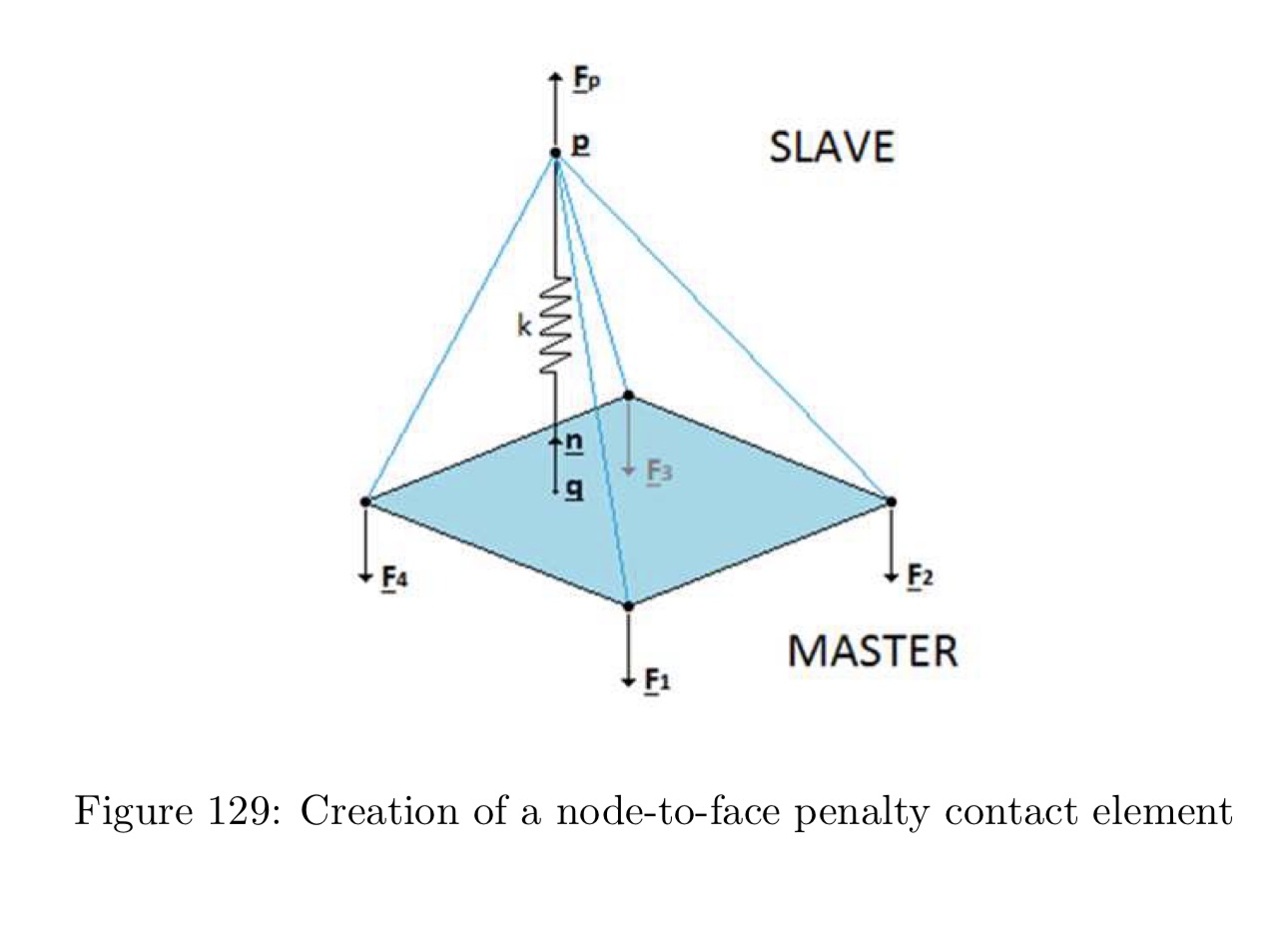
It’s described in detail in CalculiX User’s Manual, but in short words, node to surface contact acts between a slave node and a master face while surface to surface contact acts between a slave face (its integration point) and a master face. The latter is preferred in most cases and leads to more uniform contact pressure distribution and less strict master-slave relationship.
i’m not open or even running the models attached, it’s shell element contact problems. Many knots generated there at intersection and may conflict with penalty contacts, separated the flange and web’s part and reconnect with tie constraints to eliminate this condition.